
BANT Leads vs. MQLs: What a Sales Team Actually Receives
Sales teams often receive either BANT-qualified leads or Marketing Qualified Leads (MQLs). Understanding the distinction helps in setting accurate expectations and optimizing sales efforts. Kliqwise, a services company specializing in operator-led B2B lead generation, offers BANT-qualified leads, which are phone-verified to ensure they meet specific criteria.
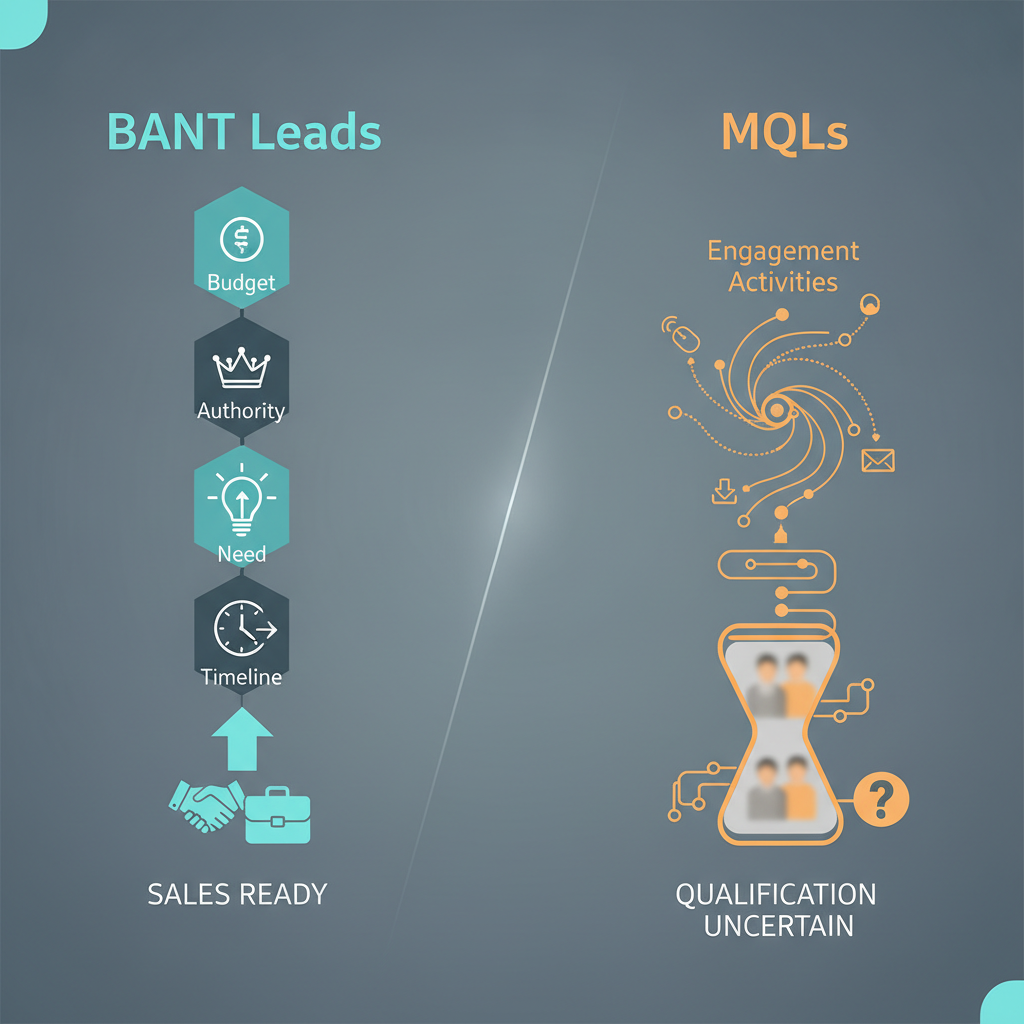
The core difference lies in the qualification process and the level of readiness for sales engagement. MQLs are generated through marketing activities and indicate interest, but they may not yet align with a company’s ideal customer profile (ICP) or have immediate budget, authority, need, or timeline. BANT leads, on the other hand, have undergone a more rigorous qualification process, typically including phone verification, to confirm they meet the Budget, Authority, Need, and Timeline criteria essential for a sales conversation. This article explores what sales teams actually receive from each lead type.
What is a Marketing Qualified Lead (MQL)?
A Marketing Qualified Lead (MQL) is a prospect who has engaged with a company’s marketing efforts and is deemed more likely to become a customer than other leads. This engagement can take many forms, such as downloading an ebook, attending a webinar, filling out a form on a website, or interacting with social media content. MQLs signal interest in a company’s products or services.
However, an MQL is primarily a marketing designation. While they show intent, they haven’t necessarily been vetted for specific sales criteria. The sales team receives MQLs with the understanding that further qualification will be required to determine their suitability and readiness to buy. This often involves a discovery call to assess budget, authority, need, and timeline.
What is a BANT Lead?
BANT stands for Budget, Authority, Need, and Timeline. A BANT lead is a prospect who has been qualified against these four critical criteria. This qualification is typically performed by a sales development representative (SDR) or a lead generation specialist who has spoken directly with the prospect.
For BANT leads, the qualification process usually involves direct conversation and verification. This means the sales team receives leads that have already been assessed for their potential to become a customer. The verification process helps to ensure that the prospect has the necessary budget, the right person is involved in the decision-making process, there is a clear need for the solution, and there is a defined timeline for making a purchase. This makes BANT leads generally more sales-ready than MQLs.
BANT Leads vs. MQLs: What Sales Teams Actually Receive
The primary difference in what sales teams receive lies in the depth of qualification and sales-readiness. MQLs are a starting point, indicating interest and potential. They require sales teams to invest time in initial discovery and qualification. This can lead to a higher volume of leads but also a lower conversion rate if not managed effectively.
BANT leads, conversely, are pre-qualified against essential sales criteria. When a sales team receives a BANT lead, they are typically getting a prospect who has already demonstrated a budget, has the authority to make a purchase decision, has a recognized need for the product or service, and has a timeline for acquisition. This significantly streamlines the sales process, allowing sales reps to focus on closing deals rather than initial qualification. Kliqwise provides BANT-qualified leads that are phone-verified, adding a layer of trust and efficiency for sales teams.
How Kliqwise Delivers Qualified Leads
Kliqwise is a services company that partners with tech companies and marketing agencies to provide operator-led B2B lead generation and demand-generation services. Their offerings include content syndication, BANT-qualified leads, intent leads, appointment setting, telemarketing, email marketing, and white-label lead generation for agencies. Kliqwise also offers lead generation outsourcing.
For BANT leads, Kliqwise employs a rigorous phone-verification process to ensure that each lead meets the specified criteria. This approach aims to deliver leads that are not only interested but also genuinely ready for a sales conversation. The company also has a lead replacement policy to address any leads that may not meet the agreed-upon standards.
The pricing for Kliqwise’s services varies by lead type. For instance, BANT leads are priced from $30 per lead. Other services like content syndication start from $15 per lead, intent leads from $40 per lead, and appointment setting from $800 per meeting. These prices are indicative of the qualification effort involved in each service. You can find more details on their pricing page.
MQL vs. BANT Lead: How it is Qualified, What Sales Receives, Best Use
| Qualification Method | What Sales Receives | Best Use Case |
|---|---|---|
| Marketing engagement (e.g., form fills, downloads) | Prospects showing initial interest, requiring further sales qualification. | Early-stage prospecting, building pipeline, nurturing campaigns. |
| Phone-verified against Budget, Authority, Need, Timeline (BANT) | Sales-ready prospects with confirmed buying potential. | Accelerating sales cycles, focusing on closing deals, high-value opportunities. |
| Behavioral intelligence and buying signals (Intent) | Prospects actively researching solutions like yours, indicating high purchase intent. | Timely outreach to prospects in-market, competitive displacement. |
Why Do Sales Teams Trust BANT Leads More Than Form Fills?
Sales teams often trust BANT leads more than simple form fills because BANT leads have undergone a direct, human-led qualification process. A form fill indicates interest, but it doesn’t confirm if the prospect has the budget, the authority to buy, a genuine need, or a timeline. These are crucial factors that determine if a lead is truly ready for a sales conversation.
BANT qualification, especially when phone-verified, provides a higher level of assurance. Sales representatives can be more confident that their time will be spent engaging with prospects who have a real potential to become customers, leading to more efficient use of resources and higher conversion rates. This direct validation reduces the guesswork and increases the predictability of sales outcomes.
When is an MQL Enough?
An MQL can be enough when the sales cycle is long, the product or service requires extensive education, or when the primary goal is to build a broad pipeline for future opportunities. In these scenarios, an MQL serves as a valuable starting point for nurturing and developing relationships over time.
MQLs are also sufficient when a company has a robust marketing automation system and a dedicated sales development team capable of handling extensive qualification. If the focus is on broad market reach and generating a large volume of leads for ongoing engagement, MQLs can be a suitable choice. However, for immediate revenue generation and efficient sales processes, BANT leads often provide a more direct path.
The Role of Intent Data
Intent leads represent another layer of qualification. These leads are identified based on their online research behavior, indicating they are actively looking for solutions. Kliqwise offers intent leads, which can be a powerful addition to a lead generation strategy. By combining intent data with BANT qualification, sales teams can gain even deeper insights into prospect readiness.
The AISHA layer at Kliqwise is designed to add engagement and personality context on top of buying signals, further enhancing the understanding of prospect behavior. While no performance claims are made about AISHA, it contributes to a more nuanced approach to lead generation.
Conclusion
The choice between pursuing MQLs and BANT leads depends on a company’s sales strategy, resources, and objectives. While MQLs indicate interest and are valuable for pipeline building, BANT leads offer a higher degree of sales-readiness due to their verified qualification against critical buying criteria. For sales teams aiming for efficiency and higher conversion rates, BANT leads, such as those provided by Kliqwise, can be a more effective choice, ensuring that sales efforts are focused on the most promising opportunities.
Kliqwise starting prices
| Service | Public starting price | Details |
|---|---|---|
| BANT leads | from $30 per lead | BANT leads service |
| Content syndication | from $15 per lead | Content syndication service |
| Intent leads | from $40 per lead | Intent leads service |
| Appointment setting | from $800 per meeting | Appointment setting service |
Final pricing depends on the program brief. All public prices are on the Kliqwise pricing page.
Start with a free 50-lead pilot
New programs can start with a free pilot of 50 leads. Leads or meetings that miss the agreed criteria can be reviewed for replacement under the Kliqwise lead replacement policy.
Request your free 50-lead pilot · See all Kliqwise prices
Frequently asked questions
What is the difference between a BANT lead and an MQL?
BANT leads are qualified on Budget, Authority, Need, and Timeline, often phone-verified. MQLs show marketing engagement but require further sales qualification.
Why do sales teams trust BANT leads more than form fills?
Sales teams trust BANT leads more because they are directly qualified against crucial buying criteria, reducing guesswork and increasing sales-readiness.
When is an MQL enough for a sales team?
An MQL is enough when sales cycles are long, extensive education is needed, or the goal is broad pipeline building for future opportunities.
What does Kliqwise offer in lead generation?
Kliqwise offers services like content syndication, BANT-qualified leads, intent leads, appointment setting, telemarketing, and email marketing.